

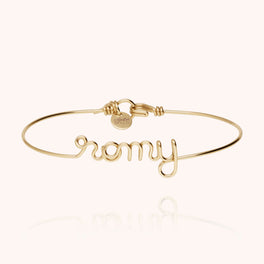
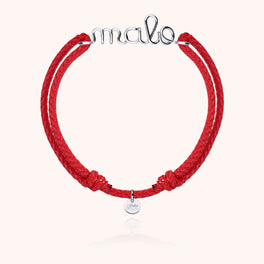
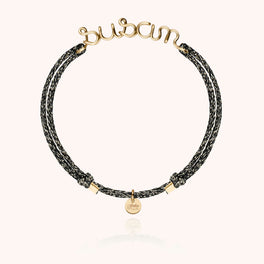



The women's tennis bracelet is designed to accompany the wrist every day, under a shirt sleeve or during sport, without ever feeling too heavy or sliding out of place. But behind the apparent simplicity of a line of stones set along a wire lie precise technical choices: the metal, the weight of the wire, the type of clasp, the wrist size. Getting one of these parameters wrong means ending up with a bracelet that spins around the wrist, feels too heavy for daily wear, or opens on its own during the day.
In this guide, we explain how to navigate between sterling silver, 14k gold-filled and 18k gold, which clasps to favor depending on use, and why the hand-shaped wire from Atelier Paulin — a Parisian Maison since 2014 — changes how a tennis bracelet holds up over time compared with an industrially made piece.
What a tennis bracelet really is, and who it suits
The name "tennis" comes from a historic anecdote linked to a player who lost her bracelet of stones during a match: ever since, this name has applied to any bracelet made of a continuous line of stones (cubic zirconia, diamonds or colored stones) set on a precious metal wire, wrapped in a rigid or semi-rigid loop around the wrist.
It's a bracelet worn every day, alone or stacked with other pieces. On the market you'll find very rigid versions, worked as a single block, and more supple versions where each link follows the movement of the wrist more closely. The second family is generally more comfortable for everyday wear, particularly for slender wrists or for stacking with other bracelets.
To better understand the differences between hand-shaped wire and clasps suited to daily wear, our dedicated guide to women's bracelets in general covers wire, clasp and correct size piece by piece — a useful foundation before narrowing the choice down to the tennis style.
Those looking to pair a tennis bracelet with a necklace or a ring can also browse the full bracelet collection, to compare weight and materials side by side before deciding.
Sterling silver, gold-filled or 18k gold: which material to choose
The material affects the weight, color, durability and price of the tennis bracelet, and it's the first decision to make.
Sterling silver contains 92.5% pure silver. Bright, luminous white color, it's hypoallergenic and antibacterial — a suitable choice for sensitive skin. It is, however, a "living" metal: on contact with air, moisture or chemicals, a light oxidation patina can appear, a natural and reversible phenomenon that's removed with lukewarm soapy water and a soft cloth. Unlike gold-filled, it should be removed before pool, shower and sports.
14k gold-filled (585/1000) is a solid layer of 585/1000 gold applied by heat or pressure onto a brass or bronze base. It contains 50 to 100 times more gold than traditional gold plating. It requires no particular care and is water-safe: shower, pool and beach are all fine. The only precaution is to remove it during intense physical activity, to preserve the delicacy of the hand-shaped wire. Available in yellow and rose.
18k gold (750/1000) is a solid gold wire made of 75% pure gold, known as the gold of French tradition. Each piece is hallmarked, certified and hand-shaped by a jeweler-artisan of the Maison. Available in yellow, rose and white — the only one of the three materials also available in white.
To compare weight and color rendering alongside other hand-shaped wire pieces, the bracelet collection presents the full range of materials side by side.
Wire weight and comfort: why an overly heavy tennis bracelet wears poorly
A tennis bracelet lives on the wrist all day: the weight of the wire holding the stones directly determines the comfort of wear. A wire that's too thin risks bending under the repeated weight of the stones; a wire that's too thick unnecessarily weighs down an everyday gesture like fastening a watch or writing.
At Atelier Paulin, the wire is a single piece: one precious metal wire, hand-shaped, never an assembly of links welded end to end. After shaping, the entire piece is work-hardened — a cold-working process that gives the metal its shape memory and resilience, carried out on the whole piece, never link by link. At points of tension, laser micro-welding reinforces the structure: the hand-shaped wire is micro-welded, never "weld-free."
This balance between the flexibility of the wire and targeted reinforcement is what allows a tennis bracelet to follow the wrist without excessive rigidity, while remaining resistant to years of daily wear.
Those wishing to pair their tennis bracelet with a piece of personal significance can also look at the more love collection, designed to accompany everyday gestures with a discreet symbol on the wrist.
Clasp and size: the two details that prevent disappointment
The clasp is what determines whether the tennis bracelet stays in place all day. Lobster and box clasps with a safety catch offer enhanced security for active daily wear, while spring-ring clasps remain more discreet but require a bit more attention when fastening, particularly for slender wrists handling the piece alone.
The right size is measured on the wrist, not the hand: a tennis bracelet that's too loose turns around the wrist and exposes the stones to more impact, while a model that's too tight marks the skin after several hours. Taking the wrist measurement with a flexible tape measure, or failing that a piece of string measured afterward, remains the most reliable step before ordering.
For those still hesitating between wire, clasp and size on a bracelet more broadly — not just tennis style — the guide women's bracelet: how to choose the right wire, clasp and size details each option step by step, including for atypical wrists.
A useful men's reference point for comparing weight and clasp, particularly if the bracelet is intended for mixed wear, can be found in our guide men's tennis bracelet.
Manufacturing, guarantee and care: what to expect from an Atelier Paulin tennis bracelet
Since 2014, Atelier Paulin has hand-shaped its jewelry in its own Parisian atelier, wire by wire. Hand-shaping times vary by material: 1 to 3 business days for sterling silver and gold-filled, 2 to 5 business days for 18k gold — these times cover the work done at the atelier, not delivery. Home delivery then takes 2 to 5 days, tracking and insurance included. For those in Paris, two additional options: personalization directly in-boutique in about thirty minutes, or same-day delivery by courier.
Every tennis bracelet is covered by a 1-year guarantee from the date of purchase. The exception is gold-filled, whose shine is guaranteed for life. Upon delivery, the piece is presented in a jewelry box — no cotton pouch, no separate artisan certificate.
Care varies by material: gold-filled is water-safe and requires no particular attention except during intense sports; sterling silver, on the other hand, should be protected from pool and shower, and can develop a natural, reversible patina.
A non-personalized tennis bracelet can be refunded or exchanged. Those wishing to explore other hand-shaped wire pieces can visit the bracelet collection or the atelier's new arrivals page.
Frequently Asked Questions
Can a women's tennis bracelet be personalized with an initial or a name?
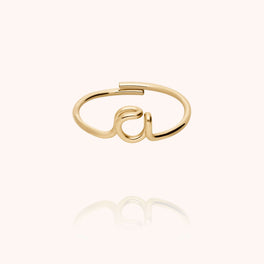
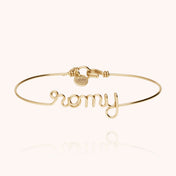
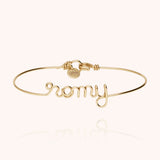
It depends on the model: not all tennis bracelets from the atelier are personalizable, and this is noted case by case on the product page. When personalization is available, it can take the form of a hand-shaped word in lowercase cursive (except the initial J, which is uppercase) or an initial referring to one or more first names. Accents and apostrophes cannot be hand-shaped, but spaces can be added on request.
What's the difference between 14k gold-filled and 18k gold for a tennis bracelet?
14k gold-filled (585/1000) is a solid layer of gold applied onto a brass base: lightweight, water-safe, available in yellow and rose. 18k gold is a solid gold wire made of 75% pure gold, hallmarked and certified, also available in white. The 18k gold is heavier and more precious, while the gold-filled option is more accessible for intensive everyday wear.
Can you shower or swim with a sterling silver tennis bracelet?
It's not recommended: sterling silver, while hypoallergenic and antibacterial, is a "living" metal that can oxidize on contact with chlorinated water, salt water or prolonged moisture. It's best to remove it before pool, shower and sports, then care for it with a soft cloth. Gold-filled, on the other hand, is water-safe and doesn't require this precaution.
How long does it take to receive a custom tennis bracelet?
Hand-shaping at the atelier takes 1 to 3 business days for sterling silver and gold-filled, 2 to 5 business days for 18k gold. Home delivery adds 2 to 5 days, tracking and insurance included. Those in Paris can also pick up their personalized piece in-boutique in about thirty minutes.
How do you choose the right size for a tennis bracelet?
Measure your wrist circumference with a flexible tape measure, or alternatively with a piece of string then measured with a ruler, adding a few millimeters for comfort depending on the model's rigidity. A tennis bracelet that's too loose turns around the wrist and exposes the stones to more impact; too tight, it marks the skin after several hours of wear.
Discover the full range of hand-shaped bracelets, from sterling silver to 18k gold, in Atelier Paulin's bracelet collection — handcrafted in Paris since 2014.
Article by Emma Van Baal — Editorial, Atelier Paulin. Discover the author
