







Anyone searching for information on a gold bar almost always does so for one precise reason: understanding how to preserve or pass down value through gold. But gold isn't just a bar locked in a safe — it's also, and has always been, a material that is worn, touched, and part of a daily gesture. In this article we compare the two paths: the "dormant" gold of the bar and the "living" gold of hand-shaped wire, the kind Atelier Paulin has worked since 2014 in its Paris workshop. The goal isn't to convince you to choose one over the other, but to understand what really differs — weight, karats, shape, use — before deciding where to let your gold live.
Gold bar: what it is and how its value is measured
A gold bar is a cast block, generally of fine gold (999.9/1000 or 999/1000), sold for its weight and purity, regardless of any shape or function. Its value is calculated by the gram or ounce, based on the daily gold price on international markets. It's an investment tool, designed to be kept, not worn.
Gold used in jewelry, on the other hand, is almost never 999/1000: too soft, it would deform. That's where karats come in. 750/1000 gold, known as 18k gold, is a solid gold wire made of 75% pure gold — also called "the Gold of French tradition." It comes in yellow, rose, and white, and it's what Atelier Paulin chooses for the most precious pieces in its collection, like some models in the necklace collection.
There's also a second path, more accessible without giving up quality: 585/1000 gold-filled, also known as 14k Gold Filled. It isn't a thin layer deposited by electrolysis like traditional gold plating — it's a solid envelope of 585/1000 gold applied by heat or pressure onto a base metal. It contains 50 to 100 times more gold than classic gold plating, which gives it the same properties as 585-thousandths gold wire. It only comes in yellow and rose, never white.
The fundamental difference with a gold bar? A bar is immobile gold. Gold wire, gold-filled or 18k, is gold that takes shape, that becomes a bracelet, a necklace, a ring — an object that is worn and that tells a story, without ever losing its metallic qualities.
Hand-shaped gold wire: the alternative that is worn
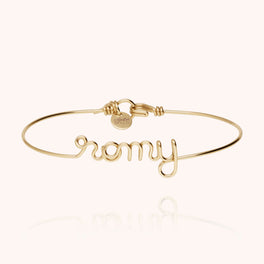
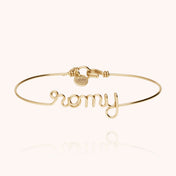
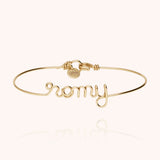
Where a gold bar is designed to stay locked away, hand-shaped gold wire is designed to be lived in. Since 2014, Atelier Paulin has hand-shaped a single wire of precious metal — sterling silver, gold-filled, or 18k gold — with no visible weld along its path, but with reinforcement points through laser micro-welding at points of tension. This reinforcement technique, not rough assembly, ensures the piece holds up over time.
The gesture is artisanal: the artisan's hand follows the wire, bends it, sculpts it in three dimensions — not a pattern carved into a flat surface as with classic engraving, but a true volume that takes shape. After shaping, the entire piece undergoes work-hardening — cold-working of the metal done on the whole piece, never letter by letter — which gives the wire its shape memory and its resilience over time.
Shaping times are fast and transparent: 24 to 48 working hours for sterling silver and gold-filled, 2 to 5 working days for 18k gold — this is the time spent in the workshop, excluding shipping. Those living in Paris can also come have their piece personalized directly at the workshop, in about thirty minutes, or have it delivered by courier the same day.
This approach is also well illustrated through everyday accessories: to understand how a hand-shaped wire piece pairs with a women's watch, the Maison has dedicated an entire article to combining the two worlds.
Weight, karats, shape: how to compare an investment and a piece of jewelry
Comparing a gold bar and a gold wire piece requires looking at three distinct, non-interchangeable criteria.
Weight. A gold bar is bought by the gram or ounce, with no other consideration. A bracelet or necklace in hand-shaped wire has a weight designed to be worn — light on the wrist or neck, never conceived as a pure store of value.
Karats. 750/1000 gold (18k, 75% pure gold) and 585/1000 gold-filled (14k, a solid envelope of gold) aren't the same thing, even though both contain real gold. Every 18k gold piece is hallmarked, certified, and hand-shaped by a jeweler-artisan of the Maison — a traceability that an anonymous bar doesn't offer in the same way.
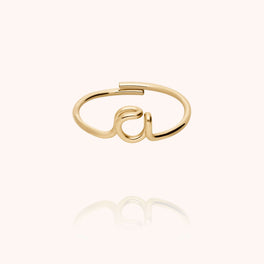
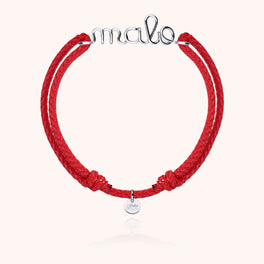
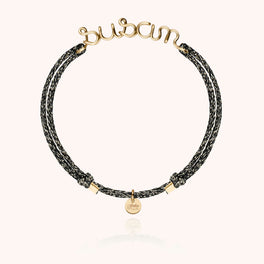
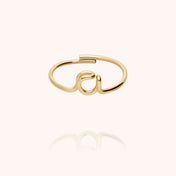
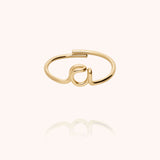
Shape. A gold bar is static. Hand-shaped gold wire, on the other hand, becomes a personalizable object: a word hand-shaped to order in lowercase cursive (except the letter "J" at the start of a word, shaped as a capital), or an initial — one or more initial letters referring to one or more names. Accents and apostrophes are not hand-shaped, but spaces can be added on request.
For those who want to wear gold rather than simply keep it, the bracelet collection shows concretely how precious wire takes shape without losing its intrinsic value.
How to care for gold: gold bar vs wire piece
A gold bar requires no upkeep: locked in a safe, it is never exposed to air, water, or friction. A piece of jewelry, on the other hand, lives with the person wearing it — and its care depends on the material.
Gold-filled requires no special upkeep: a soft cloth from time to time is enough. It doesn't fear water: showering, swimming, and the beach are all possible, unlike traditional gold plating. The only precaution, to preserve the delicacy of the hand-shaped wire's form, is to remove the piece during intense physical activity or repeated handling. Its lifespan is measured in decades.
18k gold requires no special upkeep: lukewarm water and mild soap, dried with a soft cloth, are enough.
Sterling silver, on the other hand, is a "living" metal: in contact with air, humidity, or chemical products, a thin layer of oxidation can appear — a natural and reversible phenomenon that never compromises its quality. It's maintained with lukewarm soapy water and a soft cloth, but swimming pools, showers, and sports should be avoided, unlike gold-filled.
This difference in upkeep is, in a sense, what makes a piece of jewelry alive compared to a gold bar: it requires attention, but that attention is part of the bond with the object worn every day, one that can also be paired with a men's watch without concern.
Personalizing gold: what a gold bar can never offer
The real gap between a gold bar and a hand-shaped wire piece isn't just aesthetic: it's symbolic. A gold bar represents anonymous, interchangeable value. A personalized gold wire piece, on the other hand, carries a name, a date, a bond.
Atelier Paulin offers two distinct ways to personalize. The first is the word hand-shaped to order: a word or short phrase shaped in wire, in cursive, entirely in lowercase except for the letter "J" at the start of a word. The second is the initial: one or more initial letters referring to one or more names, also available in a Capital or Capital Initial version, entirely in uppercase — distinct models that don't follow the lowercase rule.
For those who want a longer word or several names, the Mantra Original necklace holds up to five names, while the Richelieu Duo personalizes two names. Astrology also finds its place in this logic of personal meaning rather than pure value: the astrology collection offers pieces that speak of identity, not the price of gold.
Every piece comes in an individual case. And on this point, transparency is total: the warranty is one year from the date of purchase on all pieces — the sole exception being the shine of gold-filled, guaranteed for life. A piece hand-shaped to order with the word chosen by the customer cannot be exchanged or refunded, unlike a non-personalized piece.
Frequently Asked Questions
Is a gold bar worth more than a hand-shaped wire piece?
It depends on the goal. A gold bar is designed as a pure investment tool: its value is calculated only by weight and purity. A piece in 18k gold wire or gold-filled wire contains real gold, but its value also includes the artisan gesture, the personalization, and everyday wear. They aren't comparable on the same level: one is kept, the other is worn and passed down with personal meaning.
What is the difference between 585/1000 gold-filled and 18k gold?
585/1000 gold-filled, also called 14k Gold Filled, is a solid envelope of 585/1000 gold applied to a base metal, containing 50 to 100 times more gold than traditional gold plating. 18k gold (750/1000) is a solid gold wire made of 75% pure gold, hallmarked and certified. The first comes in yellow and rose, the second also in white.
Can a gold-filled piece go in water, the way a gold bar stays protected?
Yes, with no special precautions: gold-filled doesn't fear water, showering, swimming, and the beach are all possible, unlike classic gold plating. The only precaution concerns intense physical activity or repeated handling, to preserve the delicacy of the hand-shaped wire's form. A gold bar, on the other hand, is never exposed to these risks since it stays stored away.
How long does it take to hand-shape a custom gold wire piece?
Shaping takes 1 to 3 business days for sterling silver and gold-filled, 2 to 5 business days for 18k gold — this is the time spent in the workshop, excluding shipping. Home delivery then takes an additional 2 to 5 days, transit included. In Paris, it's also possible to come have your piece personalized directly at the workshop in about thirty minutes.
Can a personalized piece be returned the way a gold bar is resold?
No, not in the same way. A non-personalized piece can be refunded or exchanged. But a piece hand-shaped to order with the word or initial chosen by the customer cannot be returned or exchanged, since it was shaped specifically for that request. A gold bar, being an anonymous standardized asset, can instead be freely resold on the gold market.
Discover how gold wire takes shape in the hands of Atelier Paulin's artisans in the bracelet collection — gold that is worn, personalized, and passed down. — Emma Van Baal, Editorial, Atelier Paulin (bio)
